Understanding supplements
Do lymphatic drainage drops work? Evidence, safety & what to expect
A practical guide to the evidence, the ingredients, and the questions worth asking before you buy.
Do lymphatic drainage drops work? The short answer
Oral lymphatic drainage drops should not be treated as a proven way to relieve lymphedema or replace prescribed care. The sources reviewed for this guide do not establish that these supplements improve lymph drainage in people. That is a limit of the evidence, not proof that every botanical is ineffective.
Clinical lymphatic drainage is different: lymphedema care can involve compression, exercise, skin care, and specialist massage. A liquid herbal supplement is not an equivalent treatment.[1]
What are lymphatic drainage drops?
“Lymphatic drainage drops” is a shopping term for oral liquid supplements marketed for lymphatic wellness. It does not identify one standardized formula. Before comparing two bottles, compare the actual ingredients and serving instructions, not just the words on the front.
Your lymphatic system includes vessels, nodes, and organs involved in moving lymph fluid and supporting immune function. When that fluid builds up because drainage is impaired, the resulting swelling is called lymphedema. Cancer treatment is one possible cause; unexplained swelling deserves an assessment, not a self-diagnosis based on an advertisement.[2]
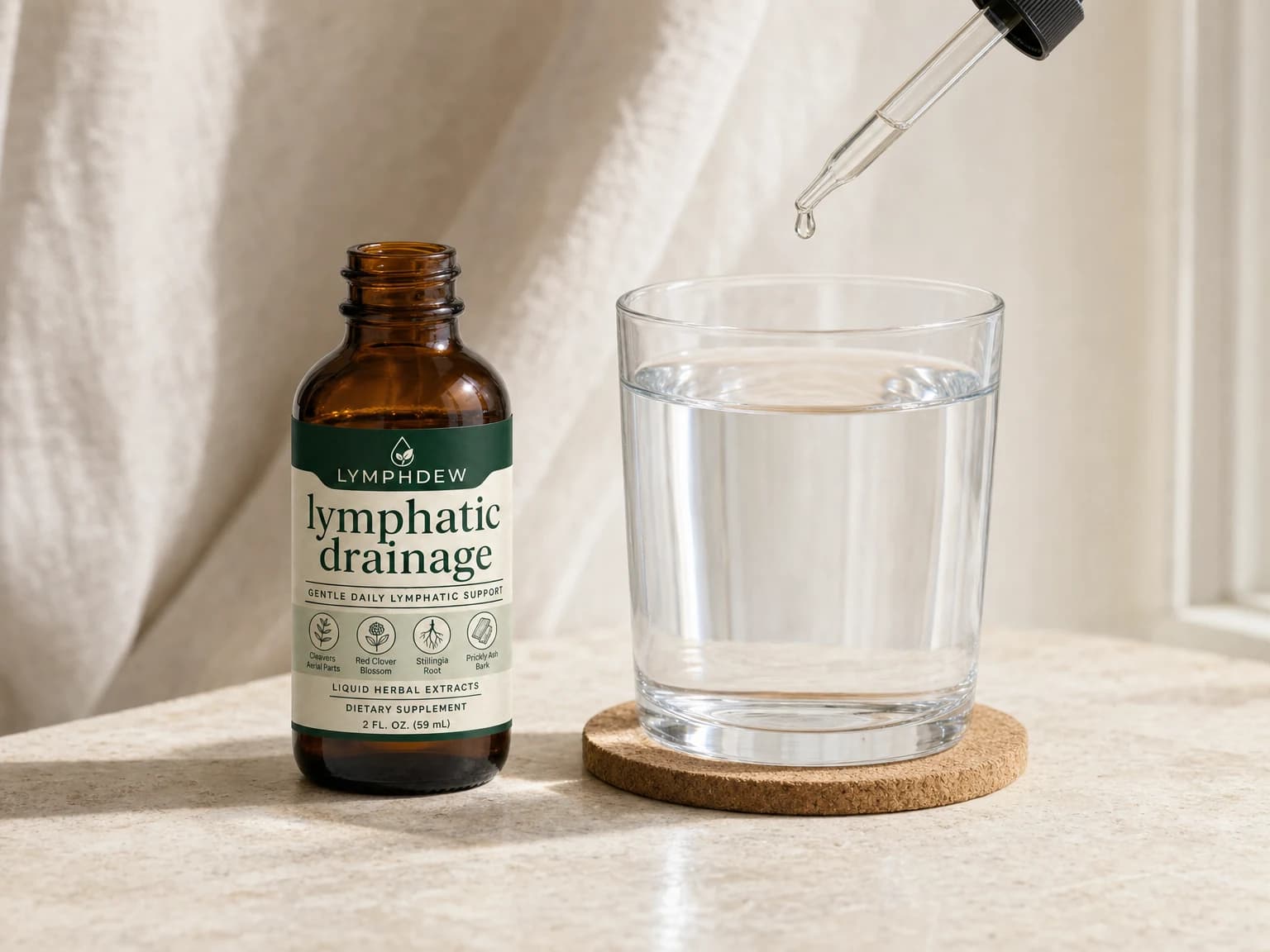
At LymphDew, our featured botanicals are cleavers aerial parts, stillingia root, red clover blossom, and prickly ash bark. Those names describe the product’s ingredients; they do not, by themselves, demonstrate a clinical effect.
What does the evidence actually say?
The useful question is more specific than “Is this herb good for lymph?” Ask whether the finished formula, at its labeled serving size, was studied in people for the outcome you care about. NCCIH notes that supplements sold to consumers can differ from the preparations used in research.[3]
Ingredient research is not a product trial
For example, a 2022 study of cleavers (Galium aparine) investigated an extract in rats exposed to acetaminophen-related liver injury. It did not test lymph drainage, a commercial dropper blend, or results in humans. Our interpretation: citing that study would not justify a claim that drops reduce someone’s swelling.[4]
Red clover has been studied in people, especially in relation to menopausal symptoms. NCCIH describes the evidence as inconclusive and some findings as inconsistent. Those studies do not establish that a red-clover-containing blend improves lymphatic flow.[5]
This guide does not provide clinical-trial evidence for LymphDew, stillingia root, or prickly ash bark as treatments for lymphatic dysfunction. A plausible explanation, a tradition of use, and a measured benefit are different kinds of evidence.
| What you see | What to ask next |
|---|---|
| “Traditionally used” | Is there relevant human research beyond a history of use? |
| “Clinically studied ingredients” | Was the same extract and amount tested, or a different preparation? |
| A before-and-after photo | What else changed, and was there a comparison group? |
| “Supports wellness” | What specific outcome was measured? This is not the same as treating a disease. |
Testimonials can describe an experience, but they cannot isolate what caused a change. A useful review might tell you about taste or packaging. It is much less useful as proof of what is happening inside the lymphatic system.
How long do lymphatic drainage drops take to work?
There is no reliable, evidence-based timeline we can give for improved lymph drainage from these drops. A promise such as “visible results in three days” needs research on that specific product and outcome. Taking a supplement consistently does not turn an unverified claim into a verified one.
First define “work.” Enjoying a liquid format, noticing a change in how you feel, and measuring a reduction in lymphedema are not interchangeable results. If a clinician says a supplement is appropriate for you, discuss what you would track and when to reassess it. Do not use a trial period to delay care for swelling.
“Detox” is not a substitute for a measurable outcome, either. NCCIH reports limited, low-quality research on detox programs and no compelling evidence for detox diets to remove toxins or manage weight. That does not evaluate every drop formula, but it is a reason to question sweeping cleansing promises.[6]
What about side effects and safety?
There is no single side-effect profile for all lymphatic drainage drops: formulas and amounts differ. Plant-based does not mean risk-free. Supplements can interact with medicines, matter before surgery, and present risks for people with medical conditions. Many have not been adequately tested in children, pregnancy, or breastfeeding.[3]
Red clover is a specific example. It contains isoflavones with a structure similar to estrogen, and NCCIH warns that red clover supplements may be unsafe during pregnancy or breastfeeding. Ask a clinician about the complete formula, particularly if you take medication or have a hormone-sensitive condition.[5]
Bring the bottle label and your medication list to a pharmacist or clinician. Follow the labeled serving instructions; do not copy a dose from another brand’s review. If you develop side effects, stop the supplement and contact your healthcare professional. Do not interpret feeling worse as proof of a “detox.”[3]
What supports your lymphatic system?
For diagnosed lymphedema, start with an individualized care plan. The NHS describes a combination of compression, movement, skin care, and manual lymphatic drainage. Compression should be selected and fitted appropriately; it is not suitable for everyone. Specialist massage is a specific technique, not simply pressing harder on a swollen area.[1]
Muscle movement helps move lymph. Your care team can suggest activity suited to your condition and ability. The National Cancer Institute also discusses hydration, skin protection, and weight management as part of care. These are supportive habits, not reasons to abandon prescribed treatment.[2]
For someone browsing wellness products without a diagnosis, the practical starting point is simpler: ask what problem you are trying to solve. A bottle should not be the first explanation for persistent swelling, or the only response to it.
A before-you-buy checklist
If you are comparing botanical drops, keep these questions open alongside the product page:
- Can I read the complete label? Look for the Supplement Facts, serving size, ingredient amounts or proprietary-blend details, and other ingredients. Check flavorings and the liquid base, too.[7]
- Does the evidence match the bottle? Ask for the actual study behind a claim. “Science-backed” is not enough information to evaluate it.
- Has someone checked my medications? A short ingredient list does not rule out an interaction.
- What am I paying for? Compare cost per labeled serving, not only bottle volume. Equal-size bottles do not necessarily contain equal numbers of servings.
- What are the purchase terms? Confirm whether the order is one-time or recurring, who handles support, and whether opened products qualify for returns.
FDA does not approve dietary supplements before sale. An “FDA-approved supplement” claim is therefore a warning sign, not a quality advantage.[7]
When swelling needs medical care
Swelling can have causes unrelated to lymphatic drainage, including medication effects, vein problems, infection, or heart, kidney, and liver conditions.[8]
- Seek urgent medical assessment for sudden, severe, painful, or unexplained one-sided leg swelling, or swelling with redness, warmth, or fever.
- Call emergency services if swelling comes with shortness of breath, chest pain, or coughing up blood. In the United States, call 911.
- Arrange an appointment for swelling that persists or worsens rather than trying one supplement after another.[8]
Common questions
Are lymphatic drainage drops the same as lymphatic drainage massage?
No. Drops are swallowed supplements. Manual lymphatic drainage is a specialized hands-on technique used in appropriate care plans. Evidence for massage cannot be transferred to an oral supplement.[1]
Can I take lymphatic drops every day?
There is no universal schedule that applies to every formula or person. Use only as directed on the finished label, after checking suitability with a healthcare professional. A larger bundle is a purchase option, not a recommendation for a longer course.
Are liquid drops better than capsules?
A liquid may suit your preferences, but format alone does not establish effectiveness or safety. Compare the actual formula and labeled serving rather than assuming a dropper bottle works better.
Should I choose drops for weight loss or a “lymph detox”?
Do not choose them on an expectation of proven fat loss or toxin removal. The detox evidence discussed above does not support that promise, and it is not clinical evidence for LymphDew.[6]
Sources & editorial notes
Prepared by LymphDew, a botanical supplement brand with a commercial interest in this topic. This is an educational guide, not medical advice, an independent product review, or a medically reviewed article. Sources were checked on September 7, 2026. The review is focused, not systematic; a missing study in these sources is not proof that no study exists.
- NHS: Lymphoedema: treatment
- National Cancer Institute: Lymphedema
- NCCIH / NIH: Using Dietary Supplements Wisely
- Şahin and colleagues, 2022: Galium aparine L. protects against acetaminophen-induced hepatotoxicity in rats
- NCCIH / NIH: Red Clover: Usefulness and Safety
- NCCIH / NIH: “Detoxes” and “Cleanses”: What You Need To Know
- FDA: Questions and Answers on Dietary Supplements
- NHS: Swollen ankles, feet and legs (oedema)
The cited organizations do not endorse LymphDew. We have distinguished guidance about lymphedema, research about individual ingredients, and our own interpretation. Send a correction or ask a product question.